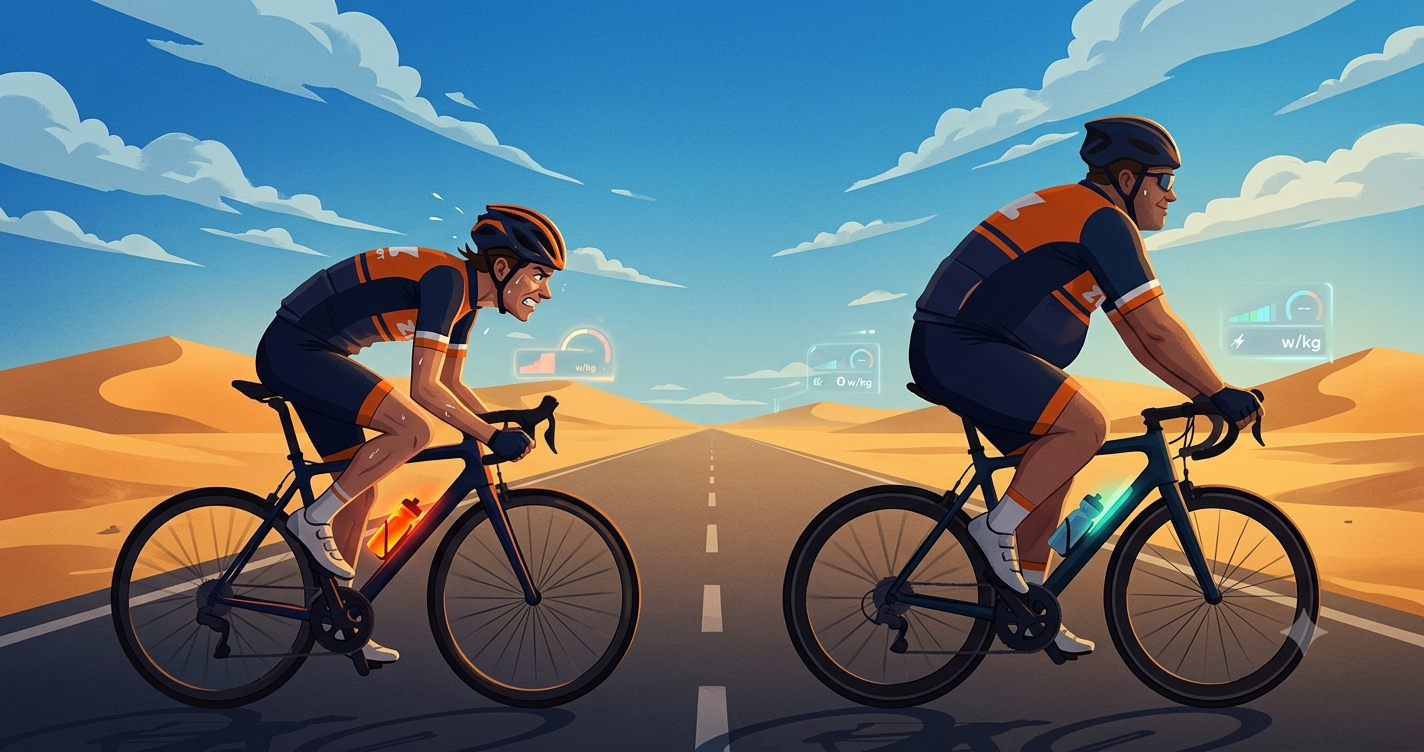
If you're a lighter rider, the physics should be on your side. Less weight, less resistance — keeping up should be easier. In road cycling generally, it is. But in a Zwift RoboPacer group on flat terrain, it works against you in a way that catches a lot of riders off guard.
The W/kg number on a RoboPacer's label is calibrated around the pacer's own body weight — 75 kg. On a gradient, that's fair to riders of all sizes. On flat ground, it isn't. Lighter riders end up working harder relative to their capacity than the number implies. Heavier riders get a cushion they didn't know they had.
What W/kg actually controls on flat ground
A RoboPacer's W/kg rating is their power output per kilogram of their own bodyweight. Miguel at 1.8 W/kg is producing 135 W (1.8 × 75 kg). On flat terrain, those 135 W push Miguel to a certain speed.
On flat ground, your speed depends on absolute watts versus aerodynamic drag at that speed — not watts per kilogram. Two riders at the same W/kg but different weights travel at different speeds on a flat road. The heavier rider, producing more absolute watts for the same relative effort, goes faster.
Miguel is doing 135 W. A 60 kg rider at the same 1.8 W/kg is only producing 108 W. They're working at the same relative intensity but moving slower. To actually hold Miguel's wheel on flat ground, they'd need to close that gap in absolute watts — which means riding at a higher W/kg than Miguel himself.
The numbers behind the penalty
Take Miguel at 1.8 W/kg (135 W). On flat ground, the table below shows what each rider's calculator output says versus the kind of absolute effort needed to match that pace:
| Rider weight | Calculator says | Effort to match pace |
|---|---|---|
| 55 kg | 99 W (1.8 W/kg) | ~2.5 W/kg to stay on |
| 65 kg | 117 W (1.8 W/kg) | ~2.1 W/kg to stay on |
| 75 kg | 135 W (1.8 W/kg) | 1.8 W/kg — matches exactly |
| 85 kg | 153 W (1.8 W/kg) | ~1.6 W/kg is sufficient |
| 95 kg | 171 W (1.8 W/kg) | ~1.4 W/kg is sufficient |
The right-column figures are directional, not precise — Zwift's aerodynamic model involves avatar height and rider position, both of which vary. But the direction is consistent: the further below 75 kg you are, the more you're working above the labeled W/kg to hold pace on flat ground. The further above 75 kg, the more cushion you have.
What are your actual watt targets?
Enter your weight to see flat-ground watt targets for all 10 RoboPacers — then use the scenario buttons to check climbing and bunch figures too.
⚡ Open the CalculatorClimbs are where lighter riders get their money back
On a gradient, the physics flips. Gravity charges you per kilogram for every metre you climb — absolute watts stop mattering as much, W/kg takes over. A lighter rider at the same W/kg reaches the same climbing speed as a heavier rider and produces fewer absolute watts doing it.
This is why lighter riders who can't hold a RoboPacer group on flat ground often surge ahead on climbs — and why heavier riders who find Tempus Fugit comfortable start losing ground the moment the road tilts up. On a climb, the 1.8 W/kg label is an accurate reflection of the effort. Flat ground is where it misleads.
Flat routes favour heavier riders. Hilly routes level things out. A lighter rider who's comfortable with a particular pacer on a rolling route may find that same pacer genuinely hard work on Watopia's flattest options.
The bunch effect compounds things
There's a second factor on flat ground: drafting. Tucked in behind a big group, the slipstream cuts your required watts by about 25%. It applies to everyone, but it matters more to lighter riders who are already working above the labeled effort just to hold pace.
Position in the bunch matters more for lighter riders on flat roads. Getting buried at the back of a strung-out group costs you the draft at the worst possible moment. Move up early, sit in the middle, use it properly.
One thing worth knowing: the calculator's bunch modifier assumes an average-weight rider. For riders well below 75 kg, the 25% saving slightly overstates the relief. You're starting from a higher relative baseline, so 25% off a bigger number doesn't fully close the gap.
Choosing the right pacer knowing this
Lighter riders can absolutely ride comfortably with RoboPacers. The label just needs a bit of translation.
On flat routes, going one step easier than usual isn't admitting defeat — it's accounting for the physics. If you're 60 kg and Maria at 2.2 W/kg feels right on hilly rides, Miguel at 1.8 W/kg is probably the more honest target for a flat day on Tempus Fugit. For hilly routes, trust the label more — W/kg is accurate on gradients and lighter riders actually have an edge there.
Before any hilly ride, check the Climbing figure in the calculator. If it's above what you can hold, the session turns into intervals whether you planned it that way or not.
On flat roads: draft as aggressively as you can. The bunch is the main thing the game gives you to offset the physics.
The flat-ground figures in the calculator are your baseline. Now you know which way to nudge them — and why a flat session that felt harder than expected wasn't a bad day. That's just the numbers doing what they do.